Tree Topology
EPOS organises the agents in a tree structure that is employed to guide the communication and information exchange up and down the tree. Aggregated knowlede is propagated in a bottom-up fashion, while feedback is propagated top-down. Consequently, the tree properties, such as the number of children of the agents, how balanced the tree is and the properties of the agents’ plans, all play a significant role in the optimization process.
In config.Configuration class, the specifics of the tree is by default defined using the following:
public static RankPriority priority = RankPriority.HIGH_RANK;
public static DescriptorType rank = DescriptorType.RANK;
public static TreeType type = TreeType.SORTED_HtL;
public static BalanceType balance = BalanceType.WEIGHT_BALANCED;
public static int numChildren = 2;
This creates a balanced binary tree which sorts the agents based on their rank. Note that the tree “structure” is generated from top to bottom, but the structure is populated by agents in a breadth-first bottom-up manner. In other words, the first agent in the sorted-by-rank agent-list will be associated to the left-most leaf (node without children), and the last one to the root spot. If you need to change the topology or modify certain aspects of it check out util.TreeArchitecture.java.
For the sake of statistical significance, the experiments should often be repeated multiple times with enabling randomness. If the tree “structure” remains the same, the randomness can be neabled by shuffling the sorted-by-rank list of agents which will consequently change the relative position of the agents within the tree structure and result in potentially different optimization process. The shuffling of this list is controlled by the shuffle parameter in the property file (for more info, check Configuration Parameters), which indicates how many times the list should be randomly shuffled. The shuffling uses a Random Generator that is initialized by a seed given by the reorganizationSeed parameter in the property file. When EPOS is repeated with the same set of values for shuffle and reorganizationSeed parameters, the same solutions are generated, enabling reproducability of the simulations. The results of repeating EPOS with various reorganizationSeed values are shown below.
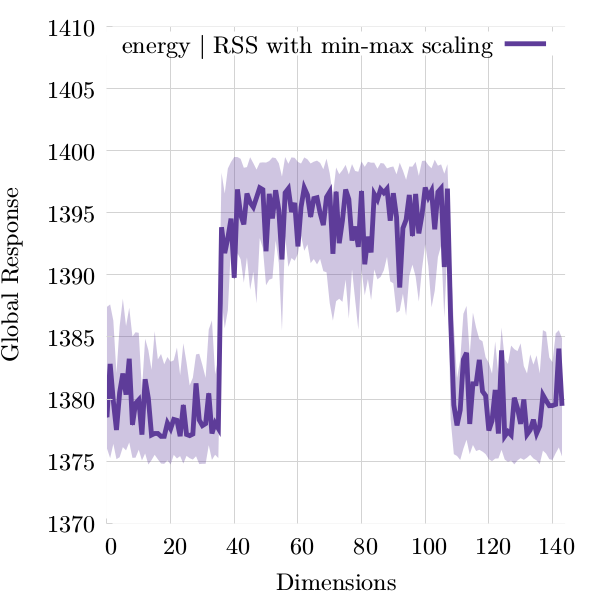
Moreover, EPOS can perform dynamic and on-the-fly agent shuffling when some criteria are met. For more info, see Tree Reorganization.
In addition, each agent in EPOS has two classes which take care of the tree communication and keep track of the parent and children nodes addresses: TreeAgent extends Agent<V> implements TreeApplicationInterface and IterativeTreeAgent extends TreeAgent. In TreeAgent the most important functions are the public void setTreeView(Finger parent, List<Finger> children) and public void setParent(Finger parent) and public void setChildren(List<Finger> list) which are called when the TreeArchitecture is finished bootstrapping and creating the tree. In IterativeTreeAgent the most important function is the public void handleIncomingMessage(Message message) which is called whenever a new message is receive by the agent. Here you can track the to-down and bottom-up phases of EPOS.